Rising sign by birth time: how fast it changes, by latitude
Reading time: 7 min · 7 sections

A rising sign can last 44 minutes or close to three hours, depending on which sign it is and how far north you were born. That is why a birth time that is close enough for your Sun and Moon can still be wrong for your rising sign, and why I check the clock before I read anything about the Ascendant.
Everything below is arithmetic you can verify. The numbers come from oblique ascension and were checked against Swiss Ephemeris timelines for real places and days; you can reproduce any of them in the birth chart calculator.
What the rising sign is, physically
Picture the eastern horizon at the minute of birth. The zodiac is a ring of twelve 30° signs laid along the path the Sun seems to follow through the year. The sign crossing the horizon in the east at that moment is your rising sign, and the exact degree on the horizon is the Ascendant. Because the sky turns once a day, all twelve signs take a turn, one after another, and the whole ring is done in about a day.
Two practical rules follow from that. First, a sunrise birth has the Sun on the horizon, so the rising sign is the Sun sign; a sunset birth puts the opposite sign on the eastern horizon. Second, the sky runs about four minutes ahead each day, so at the same clock time a month later a different sign is rising: roughly a sign per month, or two hours of clock time. A birth time is only half an answer without the date.
On average the Ascendant moves about 1° every four minutes. The average hides the real story, because the speed is far from even.
Why signs rise at different speeds
The zodiac path is tilted against the celestial equator, so it meets the horizon at a different angle depending on which part is rising. When the path lies almost flat against the horizon, the crossing point races along it and a sign is over quickly. When the path stands steep, the crossing point crawls and a sign takes much longer. In the northern hemisphere Capricorn, Aquarius, Pisces, Aries, Taurus and Gemini rise fast; Cancer, Leo, Virgo, Libra, Scorpio and Sagittarius rise slowly. The further you are from the equator, the bigger the gap.
| Signs | 0° | 30°N | 40°N | 50°N | 35°S |
|---|---|---|---|---|---|
| Aries, Pisces | 1:51 | 1:24 | 1:12 | 0:56 | 2:24 |
| Taurus, Aquarius | 1:59 | 1:37 | 1:27 | 1:12 | 2:26 |
| Gemini, Capricorn | 2:08 | 1:59 | 1:55 | 1:48 | 2:19 |
| Cancer, Sagittarius | 2:08 | 2:17 | 2:22 | 2:29 | 1:57 |
| Leo, Scorpio | 1:59 | 2:21 | 2:32 | 2:47 | 1:33 |
| Virgo, Libra | 1:51 | 2:18 | 2:30 | 2:47 | 1:19 |
Read the 40°N column the way I do: Aries and Pisces are an hour and a bit, Virgo and Libra two and a half hours. On the equator nothing is extreme, every sign lasts between 1:51 and 2:08. South of the equator the pattern flips, so the short signs are Virgo and Libra and the long ones Aries and Pisces. A real day in Sydney, at about 34°S, gives Virgo 1:20 and Aries 2:23; the table is for a fixed latitude and the real day differs by a few minutes. Further north the spread widens: at 55°N the shortest sign takes 44 minutes and the longest 2:59.
The gap is why the rising sign by birth time is a different problem from the Sun sign. A Sun sign lasts a month. A Pisces rising at 50°N lasts 56 minutes.
One day in New York, hour by hour
Here is a full day for 15 June at latitude 40.7°N, in summer time. Read it left to right and note how unequal the bands are.
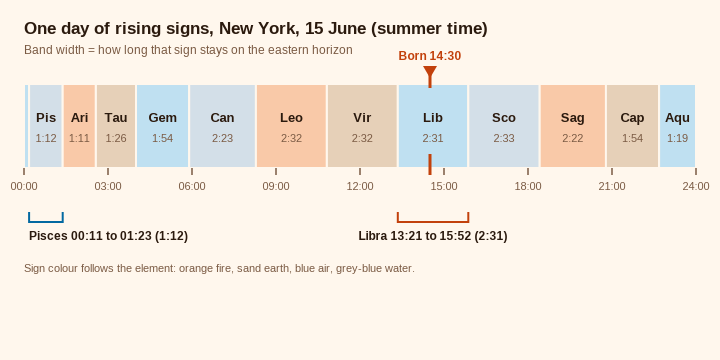
A birth at 14:30 lands in Libra, with Libra 13°41' rising. That sign holds from 13:21 to 15:52, so the recorded time is 69 minutes after the start and 82 minutes before the end: safe. Compare 00:30 on the same date. Pisces runs only from 00:11 to 01:23, and a clock 20 minutes slow gives Aquarius while one an hour fast gives Aries.
What 10, 30 and 60 minutes of error do
A quick estimate: the Ascendant moves 30° through one sign in that sign's duration, so degrees moved is the error times 30 divided by the duration. For the New York day above:
| Clock error | Libra (2:31 sign) | Pisces (1:12 sign) |
|---|---|---|
| 10 minutes | 2.0° | 4.2° |
| 30 minutes | 6.0° | 12.5° |
| 60 minutes | 11.9° | 25.0° |
The real chart agrees. In Madrid, on 23 August at 21:15 summer time, the rising degree is Pisces 7°23'. An hour later, at 22:15, it is Aries 2°55', a move of about 25.5°. At 20:50 it was Aquarius 27°26', so the 25 minutes before the recorded time put you in a different sign altogether. That is the case I keep in mind whenever someone gives me a time and says it is "about right".
Clock errors that are not about memory
The biggest errors I meet are not rounded times but a wrong offset. A São Paulo birth at 06:40 on 5 November was on summer time, UTC-2. Entered with UTC-3, the chart shows Sagittarius 4°50' rising instead of Scorpio 18°26', and the Midheaven moves from Leo 5°47' to Leo 20°48'. One forgotten hour, a different ascending sign. Browsers carry the time-zone database that records these changes, which is why the calculator reads the offset for the birth date and the birthplace's own zone, not for today and not for the zone your device is in; before 1970 that database leans on less reliable records, so older births need a second look. The Cafe Astrology ascendant page warns about the same trap, and the IANA time-zone notes explain where the history is thin.
Far north: when the pattern breaks
Above about 66.5° the arithmetic changes. Some signs never rise on some days and others stretch for hours. The Swiss Ephemeris documentation notes that Placidus cannot be calculated there, so software falls back to another house system (Swiss Ephemeris); this calculator switches to Porphyry houses and says so, and it replaces the hour strip with a short note, because there is no regular daily sequence to draw. The Ascendant itself still exists, and the calculator flips it to the correct side of the Midheaven.
The Swiss Ephemeris timeline for 15 January in Hammerfest, at 70.7°N, goes Libra, Scorpio, Taurus, Aries, Pisces, Aquarius, Leo, Virgo, Libra. Gemini, Cancer, Sagittarius and Capricorn never take a turn that day. Scorpio lasts 5 hours 22 minutes (02:03 to 07:25), while Aries and Pisces last about half an hour each. A 09:00 birth there has Taurus 11°53' rising, and I would still check it against a second source.
A routine for checking a rising sign
- Put the time in 24-hour form and confirm the offset line shows the right summer-time state for that date and place.
- Look at the window for your rising sign: its start and end on the birth day.
- Measure the distance to each edge. I treat anything within 15 minutes of a sign change as two possible rising signs, not one.
- For a rounded time, open the hour strip and list every sign between the earliest and latest plausible time.
- Read only what the candidates share. If two signs are possible, sort the statements into those both support and those only one does.
The calculator draws that strip for your birth day and place, with your time marked, so steps 2 to 4 take seconds. When the time itself is the problem, how to find your birth time covers where to look and how to bracket it. And once the rising sign is settled, reading the big three together shows how it sits with the Sun and Moon.
Common questions
Why does my rising sign change so quickly?
The sky turns once a day, so each sign crosses the eastern horizon in turn. Depending on the sign and your latitude, that crossing lasts from about 44 minutes to almost 3 hours.
Which signs rise fastest and slowest?
In the northern hemisphere Aries and Pisces are quickest and Virgo and Libra slowest. In the southern hemisphere the two groups swap, so Virgo and Libra are the quick ones.
How far off can my birth time be before my rising sign changes?
It depends where you sit in your sign's window. In a 2.5-hour sign you may have an hour either side; in an hour-long sign, 15 minutes can be enough.
Does my birthplace matter as much as my birth time?
Yes. Latitude sets how long each sign lasts, and the place also sets the time-zone offset. The same clock reading in two cities can give different rising signs.
Can I trust a rising sign for a birth above the polar circle?
The Ascendant can still be calculated, but signs rise unevenly and Placidus houses are undefined, so the calculator uses Porphyry houses and shows a note instead of the hour strip. I check such charts against a second source.

