Big three combinations: reading Sun, Moon and rising together
Reading time: 6 min · 6 sections

Someone tells you "I'm a Virgo" and expects the sentence to settle who they are. Then you open their chart and find Sun in Virgo, Moon in Leo and Pisces rising, and the single word explains perhaps a third of the picture. The big three exist to fix that: three placements, three different jobs, read as a conversation rather than a list.
I read charts every day, and the first thing I do with a big three is decide how much of each placement I can trust. Only then do I ask what they say together. The order matters, and I explain it below with two charts I have computed for this guide.
Three placements, three jobs
| Placement | Role | Changes sign | Time needed |
|---|---|---|---|
| Sun | Core drive, what you work at becoming | About every month | Date; the minute only on a sign-change day |
| Moon | Emotional needs, habits, what steadies you | Every 2 to 3 days | Date; the hour on a change day |
| Rising | First approach, the style others meet before they know you | Every 1 to 3 hours | Minute-accurate time and place |
The last column is the part people skip. A Sun sign is almost always safe; a Moon sign is safe unless you were born on its change day; the rising sign is only as good as your birth time. If your time is rounded, read the rising sign last and carefully, and look at how long your rising sign lasts at your latitude before leaning on it.
A way to read them as a conversation
- One line each. Write the role and a sign keyword: "drive: precise", "needs: warmth", "approach: soft". Do not describe the sign yet.
- Count elements and modalities across the three (tables below).
- Find agreement and friction. Where do two placements want the same thing, and where do they pull apart?
- Follow the chart ruler. The ruler of the rising sign links the three to the rest of the chart.
- Add houses last. They depend on the system and on the minute, so they are the least stable layer.
Blending by element
An element is the temperament of a sign: fire acts, earth builds, air connects, water feels. Count the three placements first. Two or three of the same element means the placements reinforce one another; one of each is a mixed team that has to negotiate.
| Pair | What the symbolism suggests | What to watch |
|---|---|---|
| Same element | Agreement, a clear and consistent style | A narrow range of reactions |
| Fire and air | Ideas feed action | Starting more than you finish |
| Earth and water | Practical care gives feeling a form | Holding on too long |
| Fire and water | Drive and sensitivity pull in different directions | Pacing, so one does not flood the other |
| Earth and air | Concrete and abstract in one head | Plans on one side, possibilities on the other |
| Fire and earth | Energy meets method | Impatience against caution |
| Air and water | Thought meets feeling | Head and heart giving two answers |
Modality adds the pace. Cardinal signs start things, fixed signs hold on and finish them, mutable signs adapt and switch. Three mutable placements are very adaptable and can struggle to settle on one course. Three fixed placements are steady and can be slow to change their mind. A missing modality is worth noticing: it often shows what you have to borrow from other parts of the chart.
Worked example: Madrid
This chart is for 23 August at 21:15 summer time in Madrid. Sun Virgo 0°11', Moon Leo 2°34', Pisces 7°23' rising.
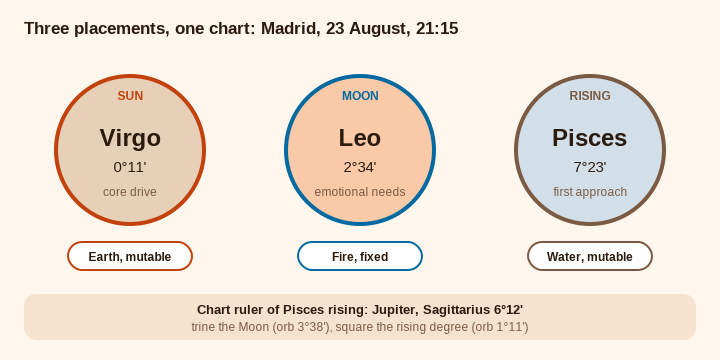
Start with trust. The Sun entered Virgo at 16:34 that day, so 21:15 is safely past it. The Moon entered Leo at 16:12. The rising sign is the weak point: Pisces holds from 20:56 to 22:08, and 21:15 is 19 minutes after the start. If the recorded time was rounded, Aquarius is possible, so I would say so and read the rising sign more lightly.
The reading itself: a Virgo Sun works at being useful, precise and improving things. A Leo Moon needs warmth, appreciation and the chance to give generously, which sits awkwardly beside Virgo's habit of criticising its own work. Pisces rising meets the world permeably and adaptively, softer than either of the other two suggests. Elements are earth, fire and water, and modalities are mutable, fixed and mutable. Air is missing from the three, which fits a person who feels and does more easily than they talk it through; the full chart has one air planet among ten.
The link is the ruler of the rising sign. I use the traditional ruler, Jupiter, for Pisces and keep Neptune as a second voice. Jupiter is in Sagittarius 6°10'. It makes a trine to the Moon (orb 3°35'), so generous belief feeds the emotional need, and a square to the rising degree (orb 1°12'), a friction between a large vision and the soft approach. In symbolic terms that is tension to work with, not a defect.
Houses come last, and they show why. With Placidus houses the Sun is in the 6th and the Moon in the 5th. With Whole Sign houses the same Sun is in the 7th and the Moon in the 6th. The signs did not change, so the reading above stands in either system.
Worked example: New York
Now 15 June at 14:30 summer time in New York: Sun Gemini 24°23', Moon Pisces 18°59', Libra 13°41' rising.
This one I would read without hesitation. The rising sign holds from 13:21 to 15:52, so 14:30 sits 69 minutes from one edge and 82 from the other. The Moon stays in Pisces from the early hours of 14 June to the morning of 16 June, and the Sun is deep in Gemini.
Elements are air, water, air; modalities are mutable, mutable, cardinal. Sun and rising speak the same language: curious, social, weighing options and talking them through. The Moon is the water placement. A Pisces Moon takes in the mood of a room, so this person can look relaxed and talkative outside while carrying more feeling than they say. Notice what is missing: no fixed sign, so nothing among the three holds a position for long.
The ruler of Libra is Venus, in Taurus 19°05' in the 8th house in both systems. Taurus is the one fixed, earthy placement in the story, so Venus brings the steadiness and taste for the tangible that the three lack. That is the use of the chart ruler: it shows where a missing quality sits.
Four mistakes I keep correcting
- Treating one placement as "the real you". The Sun is not the truth and the rest decoration.
- Reading the rising sign from a rounded time. Check the window first.
- Calling a missing element a flaw. It marks what you build with effort or borrow elsewhere.
- Turning sign keywords into predictions. They describe tendencies for reflection.
If your time is a guess, start with finding your birth time, then run your own chart in the birth chart calculator, which shows each window and a shareable card of your three.
Common questions
Which of the big three matters most?
None outranks the others. The Sun shows the drive, the Moon the emotional needs and the rising sign the approach. I read all three before I weigh any one.
What if my Sun, Moon and rising seem to contradict each other?
That is normal and often useful. Look at the elements and modalities first, then at the chart ruler. Contradiction usually marks a tension you can work with.
Do I need all three to get a reading?
No. Without a birth time you still have a Sun sign and usually a Moon sign. Read those and leave the rising sign out until the time is checked.
Which planet rules my rising sign?
Each sign has a ruling planet: Mars for Aries and Scorpio, Venus for Taurus and Libra, Mercury for Gemini and Virgo, the Moon for Cancer, the Sun for Leo, Jupiter for Sagittarius and Pisces, Saturn for Capricorn and Aquarius. Many astrologers add Pluto for Scorpio, Uranus for Aquarius and Neptune for Pisces.
Do house systems change my big three?
No. Signs and degrees are the same in every system. Only the houses of the Sun and Moon can change.

