How to find your birth time, and what to do when you can't
Reading time: 6 min · 5 sections

A birth time written as "about nine in the evening" can hold two different rising signs, and a time written as 21:15 can still be an hour out. Before I read a chart I ask where the time came from, because the answer decides how much of the chart I am willing to read.
You do not need a perfect time to learn a lot. You need to know what kind of time you have, how wide its error is, and which parts of the chart that error can touch.
Where a recorded time can come from
I rank sources by one question: was the time written down by someone present, close to the moment? I cannot tell you what a registry in your country holds for your year, so ask the registry and the hospital what exists. In some places a time is printed on the certificate, in others it was never recorded there.
| Source | What it usually is | How I use it |
|---|---|---|
| Hospital or midwife record | Recorded by someone present, often to the minute or to 5 minutes | Strongest. Copy it exactly |
| Certificate or registry extract with a time | Usually copied from the hospital notice | Strong. Note whether it says am/pm or 24-hour |
| Baby book, hospital card or wristband | Often copied from the hospital that day | Good if the handwriting is from the time |
| Birth announcement, diary, family Bible | Written within days | Good for the day, less sure for the minute |
| Timestamped photo, message or call | Created after the birth | A bound: born before 14:05 if the first text was sent at 14:05 |
| Family memory | "Around lunchtime", "just after midnight" | A range, never a minute |
The timestamp trick deserves more use than it gets. A photo of the newborn, a phone-call record or a message sent to relatives gives you a latest possible time even when nobody remembers the clock.
Check the time before you trust it
Most "wrong" birth times I see are right on paper and wrong in the form. Run this list before you blame the document:
- 12-hour mix-ups. 7:15 pm typed as 07:15 moves the chart twelve hours, and almost always changes the rising sign. The calculator echoes your time in 12-hour form (21:15 shows as 9:15 pm) to catch this.
- Midnight and noon. For a Chicago birth at 00:10 on 3 December, the rising sign is Virgo 19°48'. Typed as 12:10 it becomes a Pisces rising, because Pisces holds from 11:50 to 12:59. "12:10 am" means just after midnight.
- Rounded numbers. Staff round to 5 or 15 minutes, families to the hour or half hour. A time ending in :00 or :30 is a hint, not proof.
- Summer time. A São Paulo birth at 06:40 on 5 November was on summer time, UTC-2. Treat it as UTC-3 and the rising sign moves from Scorpio 18°26' to Sagittarius 4°50'. On the night the clocks go back, one hour happens twice, so the calculator asks which one you were born in; in spring it warns that a clock time never existed.
- Old time zones. For births before 1970 the time-zone records browsers use are less reliable (IANA time-zone notes), and summer time then varied between towns (Cafe Astrology). If you know what the local clocks showed, override the offset by hand.
The calculator prints the offset it used for your date and place. Read that line every time. A Rome birth on 10 July at 10:00, for example, takes +2, and I still compare it with what I know about the place and period, because an offset taken from a database is a guess for old births.
When all you have is "around noon"
Do not guess a single minute. Write the earliest and the latest the birth could have been, then see which signs fit inside. The Madrid evening of 23 August (summer time) shows how fast the possibilities grow:
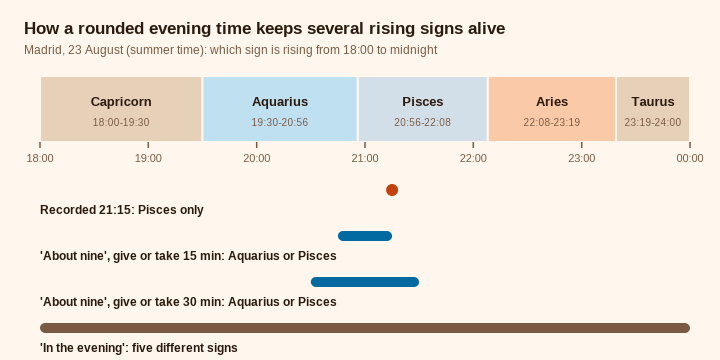
A recorded 21:15 sits inside Pisces, which holds from 20:56 to 22:08, and sits only 19 minutes after the start. If that 21:15 was rounded, Aquarius is real. "About nine, give or take half an hour" is 20:30 to 21:30: Aquarius up to 20:56, then Pisces. "In the evening" runs from Capricorn through Aquarius, Pisces and Aries to Taurus after 23:19.
The Sun and Moon behave better. On that Madrid day the Moon entered Leo at 16:12 and the Sun entered Virgo at 16:34. Before those times the answers are Cancer and Leo; after them, Leo and Virgo. The Moon changes sign every two to three days, so only a time near a change matters. Outside a change day, even a vague time gives the Moon sign.
If there is no time at all
Without any time, a chart cast for noon keeps the Moon within about 6 to 7° of where it really was (The Astrology Podcast). Planet signs and planet-to-planet aspects stay usable; the rising sign, Midheaven and houses do not. For a Sydney birth on 8 February the Moon runs from Leo 26°30' at 00:00 to Virgo 11°45' at 23:59, so you need to know the Moon's change time that day. The calculator shows that range instead of pretending to a noon position.
Narrowing a range
- List every dated fact you can find: an admission note, the time of the first call to relatives, a timestamped photo, a clock visible in a picture.
- Convert them into an earliest and a latest time in 24-hour form, in the zone and summer-time state of the place.
- Open the hour strip for that day and place and list every rising sign inside the bracket.
- Choose the approach: one sign means read it; two signs means read what both support; three or more means leave the rising sign out and read the Sun and Moon.
A 90-minute bracket can sit inside one long sign. At 40°N, Pisces and Aries last only 72 minutes, so the same bracket always spans two signs there: see rising sign by birth time for how long each sign lasts at your latitude.
Rectification, briefly
Rectification is the method astrologers use to test a time against a life. You take your bracket, cast charts at steps through it, and compare each one with dated events: moves, a change of work, the end of a relationship, a loss. The time whose angles and symbolism fit the events best becomes a working hypothesis.
I treat the result as a candidate, not a fact. The events chosen are subjective, two different times often fit equally, and a method that promises the exact minute is overselling. Use it to settle between two signs, and keep the record of your reasoning so you can change your mind.
Once you have a time you can live with, how the big three work together shows what to do with it, and the birth chart calculator keeps the window for each sign next to your result.
Common questions
Can I get my birth time from a birth certificate?
Some places print a birth time on the certificate and others do not. Ask the registry or the hospital which records exist for your place and year.
What if my parents only remember 'around noon'?
Treat it as a range, find the signs inside it with the hour strip, and read only what those signs share. The Sun and Moon are usually safe even with a vague time.
What is the quickest way to spot a wrong birth time?
Check 12-hour and 24-hour mix-ups and the summer-time offset first. Those two slips explain most changes in the rising sign.
Does rectification give an exact birth time?
No. It narrows a range by testing candidate times against dated life events and leaves you with a working hypothesis, not a proof.
Which part of the chart survives an unknown birth time?
Planet signs and aspects between planets hold. The rising sign, Midheaven and houses do not, and the Moon needs a range if it changes sign that day.

